Auxiliary Verb (Group 1) (Basic ㊦ 357)
Do something in advance for future convenience.
Equivalent: Do something in advance; go ahead and do something; let someone/something remain as he/it is
| Vて | おく | |
| 話しておく | Talk in advance | |
| 食べておく | Eat something in advance |
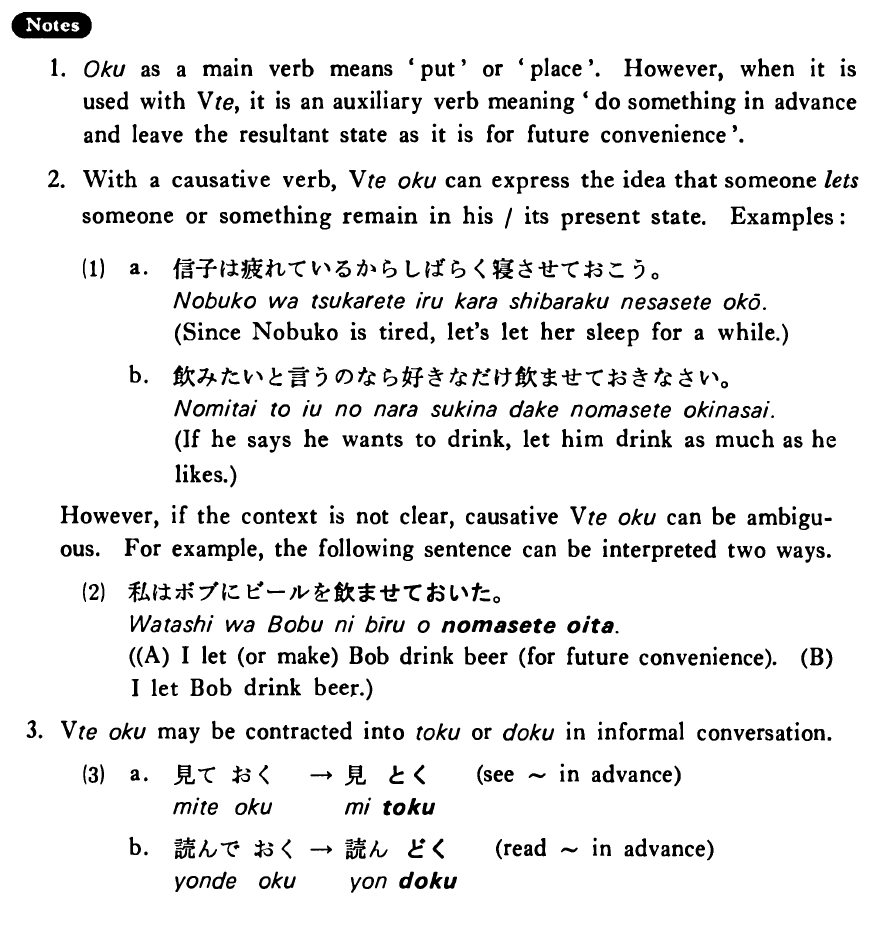
1. おく as a main verb means 'put' or 'place'. However, when it is used with Verbて, it is an auxiliary verb meaning 'do something in advance and leave the resultant state as it is for future convenience'.
2. With a causative verb, Verbておく can express the idea that someone lets someone or something remain in his/its present state. Examples:
However, if the context is not clear, causative Verbておく can be ambiguous. For example, the following sentence can be interpreted two ways.
3. Verbておく
may be contracted into とく or どく in informal conversation.